
Ground-Up Construction Loans: The Timeline Nobody Warns You About
Moving from rehab to ground up construction? See how entitlements, permits, and draw schedules set your real timeline. Read the step by step breakdown.
You've flipped a few houses. Maybe more than a few. You know how rehab lending works: buy the property, submit your Scope of Work, get your Initial Advance at closing, request Holdback releases as you complete the work, and sell or refinance when the project is done. Four to six months, start to finish.
Now someone shows you a vacant lot. The numbers look incredible. You can build a 1,600 SF house for $180K on a lot that costs $55K, and the comps say it'll appraise at $340K when it's done. That's $105K of margin before financing, holding & exit costs. Why wouldn't you do this?
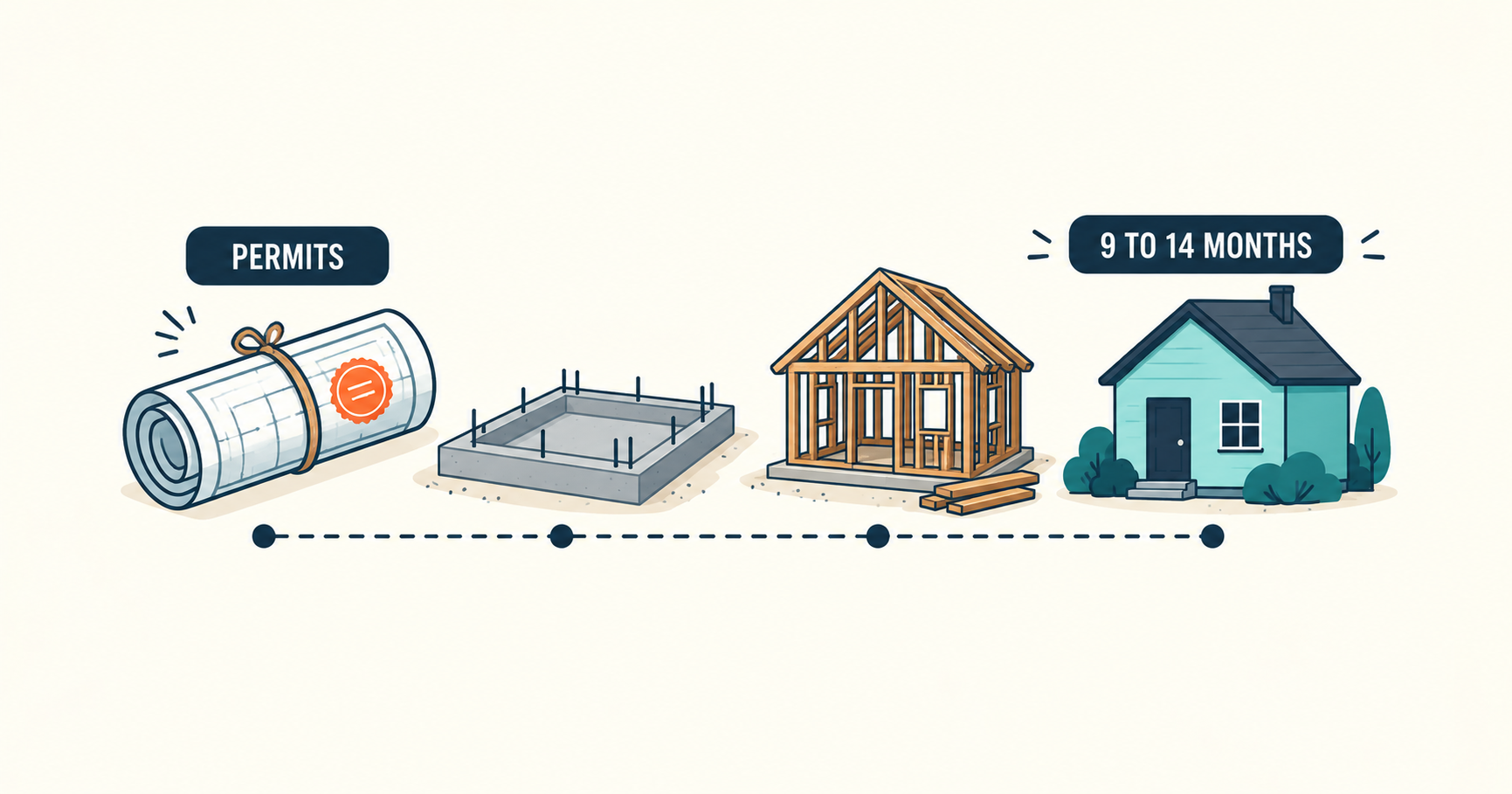
Because ground-up construction is a 9 to 14 month commitment, not a 4 to 6 month one. And the first 2 to 4 months produce zero visible progress while burning real money. The lending mechanics are similar to what you already know, but the timeline has phases that don't exist in a rehab, and those phases are where experienced flippers get caught off guard.
If you're considering your first GUC (ground-up construction) project, this is what the timeline actually looks like.
The Phases Nobody Talks About: Pre-Construction
On a fix and flip, you close and start demo the same week. Sometimes the same day. The property exists. The structure is there. You're improving it.
On a GUC project, the property doesn't exist yet. Before you can drive a single nail, you need to navigate a sequence of approvals, permits, and site preparation steps that can take 8 to 16 weeks depending on the municipality. This is the pre-construction phase, and it's where most of your timeline risk lives.
Entitlements and Zoning
Before anything else, you need to confirm the lot is zoned for what you want to build. Single-family residential zoning doesn't automatically mean you can build a 2,400 SF house on a 5,000 SF lot. Setback requirements, lot coverage limits, height restrictions, and impervious surface ratios all constrain what's buildable.
If the lot requires a zoning variance or a conditional use permit, add 30 to 90 days to your timeline before you even apply for a building permit. Some municipalities require public hearings for variances. Others have planning commission review cycles that only meet monthly. If you miss the submission deadline by a day, you wait another 30 days.
This is the part of GUC that has no equivalent in a rehab. When you buy a distressed house to flip, the zoning is already established. The structure is already permitted to exist. You're renovating within an existing footprint. Ground-up construction means proving to the municipality that what you want to build is allowed on that specific piece of dirt.
What to do before you commit: Pull the zoning report for the parcel. Call the local building department and ask specifically: what can I build here, what's the maximum square footage, what setbacks apply, and does this lot require any variances for new residential construction? Do this before you go under contract on the lot. A $235K vacant lot with a zoning problem is not a deal. It's a liability.
Site Plan and Engineering
Once zoning is confirmed, most municipalities require a site plan showing the building footprint, grading, stormwater management, utility connections, driveway placement, and sometimes a tree survey. This isn't a sketch on a napkin. It's an engineered document prepared by a civil engineer or land surveyor, and it typically costs $3,000 to $8,000 depending on complexity.
If the lot has topography issues (significant grade changes, drainage problems, rock), you may also need a geotechnical report. If it's in a flood zone, add elevation certificates and potentially FEMA compliance documentation. None of this is optional. You can't pull a building permit without an approved site plan in most jurisdictions.
Timeline impact: Engineering takes 2 to 4 weeks to prepare. Municipal review of the site plan takes another 2 to 6 weeks. If they come back with revisions (common), add another 2 to 3 weeks. Total: 6 to 13 weeks just for site plan approval.
Building Permits
With an approved site plan, you can submit for building permits. This includes architectural plans (prepared by a licensed architect or designer), structural engineering, and the site plan. Some municipalities require separate permits for each trade: building, electrical, plumbing, HVAC, and sometimes grading and erosion control.
Permit review timelines vary wildly. Some suburban municipalities process residential permits in 2 weeks. Urban areas with backlogged departments can take 6 to 10 weeks. And if the plans examiner has comments (they usually do on a first submission), you revise and resubmit, which restarts the review clock.
What this means for your project budget: You're paying for the lot (either with a loan or your own cash), paying property taxes, paying insurance, and paying carrying costs on any financing already in place, all while producing zero construction progress. On a $55K lot financed at 8.5%, that's roughly $390/month in interest alone. Add engineering, architecture, and permit fees, and you could be $15K to $25K into the project before the foundation crew shows up.
How the Loan Works: Where GUC Differs from Rehab
If you've done RTL rehab deals, the lending structure for GUC will feel familiar in concept but different in execution.
Loan-to-Cost and the Interest Reserve
With many lenders, your LTC (loan-to-cost) is calculated on the purchase price plus your construction budget. On an Upright Lending GUC loan, the LTC (loan-to-cost) calculation includes an interest reserve, which gets added to both the numerator and the denominator. This means the effective leverage can be higher than you'd expect from looking at the headline LTC number alone.
At Upright Lending, GUC loans fund up to 90% LTC (+ interest reserve). The loan covers the lot acquisition plus 100% of hard and soft construction costs. Your out-of-pocket is the gap between total project cost and the loan amount, plus closing costs and reserves.
For context, here's what the leverage looks like on a typical GUC deal:
Lot purchase: $55,000. Construction budget (hard + soft costs): $180,000. Interest reserve: ~$16,000. Total project cost: $251,000. At 90% LTC: loan amount of ~$226,000. Borrower equity required: ~$25,000 plus closing costs.
That's real leverage on a project with a $340K target ARV.
The Draw Schedule: No Releases Until Foundation
Here's where GUC diverges most from rehab. On a fix and flip, you can request your first Holdback release as soon as you've completed a meaningful chunk of the SOW, sometimes within the first few weeks.
On a GUC project, no Holdback releases happen until the foundation is complete. That means the entire site preparation, grading, footings, and foundation pour happen before you see any construction funds beyond the Initial Advance.
Why? Because a half-built foundation has essentially zero recoverable value to the lender. A half-renovated house still has the underlying property value. A hole in the ground with some rebar doesn't. The foundation milestone is the point where the project has enough physical progress that the lender's collateral position is meaningful.
What this means for your cash flow: You need enough liquidity to cover the gap between closing and foundation completion. Depending on your market, soil conditions, and weather, that's 4 to 8 weeks of construction activity funded from your Initial Advance and potentially your own pocket. Budget for this. It's the number one cash flow surprise for flippers moving into GUC.
Holdback Releases After Foundation
Once you clear the foundation milestone, Holdback releases follow a similar pattern to rehab loans: you request a release, a virtual or third-party inspection verifies the work matches the construction plans and budget, and the funds are wired. There's no set minimum number of releases, but each request should represent a substantial percentage of the total project cost. Submitting a $2,000 request on a $180K construction budget creates administrative overhead that slows everyone down. Think in terms of meaningful milestones: framing complete, mechanicals roughed in, drywall and paint, finishes and fixtures.
A typical GUC draw schedule might look like this:
Release 1: Foundation complete (inspected). ~15-20% of construction budget.
Release 2: Framing, sheathing, roofing complete. ~25-30%.
Release 3: Mechanicals roughed in (plumbing, electrical, HVAC). ~15-20%.
Release 4: Drywall, paint, flooring, cabinets. ~20-25%.
Release 5: Final finishes, fixtures, landscaping, CO obtained. ~10-15%.
Each draw requires an inspection confirming the work is complete and consistent with the approved plans. The geotagged, geofenced, timestamped inspection allows us to compare what we see on site to what was in your construction budget when the loan closed. A detailed, well-organized budget makes this process faster. A vague one creates questions that delay your release.
The Real Timeline: 9 to 14 Months, Not 4 to 6
Here's what a GUC project timeline actually looks like, mapped against the financing milestones. This assumes a straightforward single-family build with no major entitlement issues.
Months 1-2: Pre-construction. Lot acquisition, loan closing, site plan finalization, permit submission. You have the lot and the loan. No construction yet. Your Initial Advance covers the lot purchase and gets you started.
Months 2-3: Site work and foundation. Grading, utilities, footings, foundation pour, backfill. First inspection happens at foundation completion. First Holdback release.
Months 3-5: Framing through dry-in. Framing, sheathing, roofing, windows, doors. Second Holdback release after framing inspection.
Months 5-7: Mechanicals and rough-ins. Plumbing, electrical, HVAC rough-in. Municipal inspections required before you can close walls. Third Holdback release after rough-in inspection.
Months 7-9: Interior finishes. Drywall, paint, flooring, cabinets, countertops, fixtures, appliances. Fourth Holdback release.
Months 9-11: Exterior, punch list, final inspections. Landscaping, driveway, exterior paint/siding finishes, final municipal inspections, Certificate of Occupancy. Final Holdback release.
Months 11-14: Sale or refinance. List the property, find a buyer or apply for a DSCR refinance to hold as a rental. DSCR refi follows the same process as a rehab-to-rental transition.
Total: 11 to 14 months from lot closing to capital recovery. Compare that to 5 to 7 months on a typical fix and flip.
That's not a knock on GUC. There are typically less unknowns that can throw the budget out of whack. Further, the margin is usually larger, and you're building exactly what the market wants instead of working with someone else's floor plan. But the capital commitment is longer, the carrying costs are higher, and the pre-construction phase is a timeline risk that doesn't exist in rehab.
What Experienced Flippers Get Wrong on Their First GUC Deal
1. Underestimating Pre-Construction Time
You're used to closing and starting work the same week. On GUC, you might close on the lot in month 1 and not break ground until month 3. Those 8 to 12 weeks of engineering, permits, and site plan review are carrying costs with no construction progress. Budget for them.
2. Running the Same Cash Flow Model as a Flip
On a flip, your out-of-pocket exposure peaks early (at closing) and decreases as you receive Holdback releases. On GUC, your exposure stays elevated through the foundation phase because no Holdback releases happen until that milestone clears. If you're running two projects simultaneously, one flip and one GUC, make sure your liquidity covers both timelines independently.
3. Using a Rehab-Level Contingency
A 5-8% contingency is reasonable on a cosmetic rehab where the structure already exists. On a GUC project, you're dealing with site conditions (rock, soil issues, water table), weather delays, material lead times, and municipal inspection schedules that add variability. 10-15% contingency is standard for ground-up. Below 10% on your first GUC deal signals to the lender that you haven't fully scoped the risk.
4. Not Having the Builder Relationship Locked
On a flip, you can GC the project yourself with a crew of subs. On GUC, most municipalities require a licensed general contractor for new construction. Your lender will want to see the GC's license, insurance, and track record of completed builds. If you're planning to self-perform as an owner-builder, verify that your state and municipality allow it and that your lender accepts it. Not all do.
5. Ignoring the Exit Timeline
A completed new build typically sells faster than a renovated house in the same market because it's new. But "faster" still means 30 days on market plus 30 to 45 days to close. That's 2 to 3 months after you obtain the Certificate of Occupancy. Your loan term needs to accommodate the full timeline: pre-construction + construction + sale/refi. On a 12-month loan term, a 2-month permit delay can put you uncomfortably close to maturity.
Running the Numbers: A Realistic GUC Pro Forma
Here's what a straightforward single-family GUC deal looks like, penciled out honestly.
The Deal :Lot purchase: $55,000. Construction budget (hard costs): $155,000. Soft costs (architecture, engineering, permits, surveys): $25,000. Interest reserve: ~$16,000. Total project cost: $251,000. Target ARV: $340,000.
The Financing: Loan amount at 90% LTC: ~$226,000. Borrower equity: ~$25,000 plus closing costs. Interest rate: 8.75% (assuming 740+ FICO at 85-90% LTC). Origination fee (1.5%): ~$3,390. Loan term: 18 months.
The Carry: Monthly interest on $226K at 8.75%: ~$1,647. Pre-construction carry (2 months, partial draws): ~$3,300. Construction carry (8 months): ~$13,180. Sale period carry (2.5 months): ~$4,118. Total interest cost: ~$20,600.
The Exit: Sale price: $340,000. Selling costs (5% agent commissions + closing): ~$20,400. Loan payoff: ~$226,000. Total project costs already in the deal: $251,000.
Net profit before taxes: $340,000 - $251,000 - $20,400 - $3,390 (origination) - $20,600 (carry) = ~$44,610.
That's a healthy return on ~$25,000 of equity. But notice what happens if the project takes 14 months instead of 12: you add another ~$3,300 in carry, and your profit drops to ~$41,300. If permits take an extra month and the sale takes an extra month, that's $6,600 off the bottom line. The margin is real, but it's sensitive to timeline, which is why the pre-construction phase matters so much.
Before You Start: The GUC Readiness Checklist
If you're an experienced flipper evaluating your first ground-up project, run through this before you commit capital.
Zoning confirmed? Not assumed, confirmed. Call the building department. Pull the zoning report. Verify setbacks, coverage, and height limits. If you need a variance, factor 60 to 90 days into your timeline before you even apply for permits.
Builder identified? Licensed GC with completed new construction projects in your market. Get references. Verify their insurance. Confirm they can start within your timeline.
Soft costs budgeted? Architecture, engineering, site plan, surveys, permits, impact fees. These run $20,000 to $30,000 on a typical SFR build and they're due before construction starts.
Liquidity covers the foundation gap? You need enough cash to fund the gap between your Initial Advance and the first Holdback release at foundation completion. On the deal above, that's roughly $15,000 to $20,000 in construction costs before your first Holdback release, plus soft costs that may not all be funded by the loan.
Loan term covers the full cycle? Pre-construction + construction + sale/refi. If you estimate 12 months total, take a 15 or 18-month term. A bit of an increase to your rate is minimal compared to the stress of a maturity default and the cost of one or two loan term extensions.
Contingency at 10% or higher? This is your first build. Unknown site conditions, weather, and permitting delays are real. Build the cushion now.
The Bottom Line
Ground-up construction is where the best margins in residential real estate live. But it's not a flip with a longer timeline. It's a fundamentally different project with phases, risks, and capital requirements that don't exist in flipsi.
The investors who do this profitably plan for the pre-construction timeline, budget soft costs and contingency accurately, and work with a lender who understands the draw schedule, the inspection cadence, and the reality that GUC projects take 9 to 14 months, not 4 to 6.
If you've done the rehab deals, you already understand leverage, construction management, and exit strategy. The jump to GUC is learning the front-end process and budgeting the carrying cost for a longer cycle.
Upright Lending funds ground-up construction loans with up to 90% LTC, 100% of construction costs financed, virtual inspections, and quick holdback releases structured around your actual build schedule. If you're evaluating a lot and want to know if the numbers work, we'll review your pro forma before you commit.
Call (216) 206-6079 or start your application at uprightlending.com.
Already have a lot under contract? Upload your purchase agreement and construction budget through your uprightlending.com account for a same-day term sheet.
Ready to fund your next deal?
Partner with a lender who understands your investment strategy.
Subscribe to Our Blog
Get the latest insights, market trends, and investment strategies delivered to your inbox.