
How to Move From Single-Family Flips to Small Multifamily
Moving from single-family flips into 2 to 10 unit deals? Here is how the financing works: RTL up to 92.5% LTC, bridge to stabilize, DSCR to hold.
You already know how to renovate and sell a house. Here is how the same financing path carries you into 2 to 10 unit deals, from acquisition through rehab, stabilization, and a long-term hold.
You have run enough single-family projects that the work has a rhythm to it. You know your contractor's pace, you know what a kitchen costs, you know within a few thousand dollars what a house will appraise for when it is finished.
Then a small apartment building shows up in your market. Four units, tired, priced like the seller is done being a landlord. The rents are under market by a couple hundred dollars a door. You do the back of the napkin math and it is better than the last three houses you looked at.
And then you hesitate. Not because you cannot do the work. Because you are not sure how the money works.
That is the real gap between a single-family investor and a small multifamily investor. It is not construction skill. It is knowing how a 2 to 20 unit deal gets financed, renovated, stabilized, and held, and having a capital partner who does all four.
Here is how that path works.
Why Small Multifamily Is the Natural Next Step
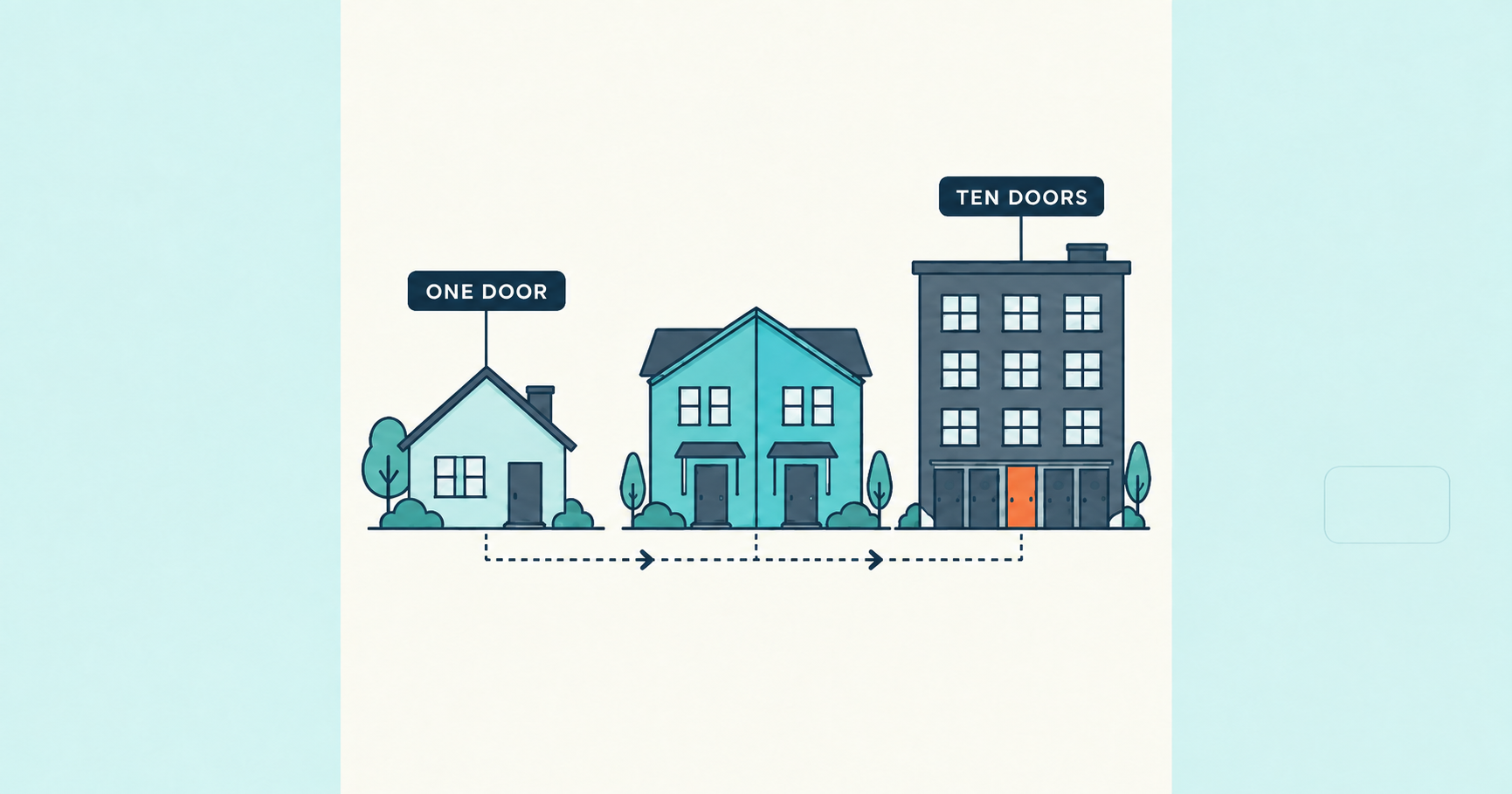
The step from one door to four is smaller than it looks, and it pays you differently.
You close once and get multiple units. One title search, one appraisal, one loan, one closing, one roof, one insurance policy. Compared with buying four houses on four separate transactions, you are doing a fraction of the work per door.
You also get more than one way to be right. If one unit sits empty for a month in a fourplex, you still have three paying rents. That is a meaningfully different risk profile than a vacant single-family rental where your occupancy is either 100% or zero.
And the value you create is measurable in a way flippers already understand. On a flip, you create value with finishes and comps. On a small multifamily deal, you create it by raising rents to market and cutting the operating drag the last owner tolerated. Same instinct, different lever.
The math changes from comps to rents
This is the one real mental shift, so it is worth being direct about it.
On a single-family flip, your exit number comes from comparable sales. You renovate to what the neighborhood will pay and you sell.
On a small multifamily deal, once you get past a duplex, the building's value is increasingly a function of what it earns. Your job is not just to make it look good. It is to make it produce, unit by unit, and to document what it produces.
That changes what you underwrite before you buy. You want the current rent roll, what the units would rent for once renovated, what the taxes and insurance actually run, and an honest read on utilities and maintenance. That is the file you build your budget and your exit around.
{{teal-solid-stack}}
The Same RTL That Funds Your Flips Funds Up to 20 Units
Here is the part most investors are surprised by: you do not need a different kind of lender for this.
An RTL (Residential Transition Loan, the short-term financing behind fix and flip, new construction, and bridge deals) is the same instrument you have been using on houses. Upright Lending writes Rehab Loans on properties up to 20 units, from cosmetic updates through full-scale renovations. New Construction covers ground-up work, including 2-4 unit properties.
So the duplex, the triplex, and the eight-unit building all sit inside the product you already know. Same application, same portal, same dedicated Branch, same closings as fast as 7 days when your file is clean.
What we look at on a 2 to 20 unit rehab
The underwriting conversation gets a little richer than it does on a single house, in ways that are easy to prepare for:
The unit mix and the rent roll. Which units are occupied, what each pays, what each would pay renovated. If units are occupied, we will talk through leases and how you plan to sequence the work around them.
A scope of work that is broken out by unit. Not one lump sum for the building. Unit 1, unit 2, unit 3, plus a separate line for common areas, roof, and systems.
Your contractor's capacity for the volume. Renovating four kitchens on one timeline is a different job than renovating one. We want to see that your crew is sized for it.
Your exit. Sell the stabilized building, or refinance and hold it. Both are fine. Having a clear answer shapes the structure we put in front of you.
Bring those four things and a multifamily file moves about as fast as a single-family one. Your dedicated Branch will tell you exactly what is missing while there is still time to fix it, not the day before closing.
Build the Budget Unit by Unit
The single biggest difference in how you run the project is bookkeeping discipline on the scope.
On a house, one budget covers one building. On a fourplex, treat each unit as its own small project with its own line items, and treat the shared systems as a fifth. Roof, siding, parking, hallways, the shared water heater, the panel and any rewiring: those belong in their own section, not smeared across the units.
Do that and two useful things happen. Your funding tracks reality, and your capital comes back sooner.
Holdback releases on a multi-unit scope
Rehab dollars come back to you through Holdback releases as work gets completed. On a multi-unit building, that is a real advantage over a single-family project, because you finish work in stages.
When unit 1 is done, you submit for release on unit 1 while your crew moves into unit 2. You are not waiting for the entire building to be finished to see money. You submit through the Upright portal, your Branch reviews it with full context on your scope and budget, and review is measured in hours.
For a full-time investor running three or four projects at once, that staged recycling is the difference between a fourplex tying up your cash for six months and a fourplex returning capital the whole way through.
Stabilize Before You Rush the Refinance
Renovation finishing is not the same thing as the building being ready for permanent financing. A lender pricing a long-term loan wants to see the building performing, and performing means leased.
That takes time. You have to market the units, screen tenants, sign leases, and let the rent roll become a fact instead of a projection. Trying to compress that into the last two weeks of a short-term loan term is where good deals get sold at a discount.
Upright's Stabilization (Bridge) loans exist for exactly this window. Short-term financing on a completed property so you have time to lease it, sell it, or refinance it without disruption. You lease the building on your schedule, hit your numbers, then take out the loan with the rent roll you actually wanted to show.
For a first small multifamily deal, that breathing room is worth planning for from day one, not reaching for at the end.
Hold It With a DSCR Loan Based on the Building's Rents
Once the building is leased, you have the option that makes small multifamily so appealing in the first place: keep it.
A DSCR loan (Debt Service Coverage Ratio, long-term rental financing underwritten on the property's income rather than your personal tax returns) qualifies the building on its actual or market rents. This is where the work you did on the rent roll pays you twice, once in cash flow and once in how the property qualifies. Low rates, fast closings, and no repackaging of your personal income to make a deal work.
And because Upright covers acquisition and rehab, the bridge, the DSCR takeout, and the servicing, the handoff between stages is one continuous process with a team that already knows you, your entity, and the property. Nobody re-underwrites you and your building from scratch because it moved to a new lender. You go from RTL to bridge to DSCR with one partner and one phone number.
The lifecycle on a fourplex, start to finish
Buy and renovate on an RTL at up to 92.5% loan to cost. Pull capital back unit by unit through Holdback releases. Move to a Stabilization Bridge loan while you lease it up. Refinance into a DSCR loan and hold it, or sell the stabilized asset and put the cash into the next one.
Four stages, one team, and every stage set up to feed the next.
Where This Lands on Your Ladder
If you have 3 to 5 deals behind you, a 2-4 unit property may be the honest next move. The construction is familiar, the capital requirement is manageable at 92.5% loan to cost, and you learn multifamily operations at a scale where a mistake is a lesson rather than a crisis.
If you are running 6 to 15 deals a year, small multifamily is a way to add doors without multiplying closings. 5-10 units on one closing instead of four separate acquisitions is a real reduction in transaction drag, and it builds a rental base you can refinance and hold.
If you are doing 16 or more, you are already thinking in portfolio terms. Small multifamily gives your dedicated Branch fewer, larger files to run, and the DSCR takeout turns finished projects into cash-flowing assets you keep instead of inventory you have to sell.
The Bottom Line
Moving from single-family flips to 2 to 20 unit deals is a financing question, not a construction question. Budget the building unit by unit, plan for a stabilization window, and know your takeout before you buy.
Upright Lending finances that whole path: Rehab and New Construction loans on properties up to 20 units at up to 92.5% loan to cost, Stabilization Bridge financing while you lease up, DSCR loans for up to 10 units to hold what you built, and a dedicated team that stays with the file from application through the final Holdback release.
If there is a small multifamily deal in your market you have been circling, let's underwrite it together.
Call (216) 206-6079 or start your application at uprightlending.com.
Ready to take your first small multifamily deal down? Apply at uprightlending.com.
Ready to fund your next deal?
Partner with a lender who understands your investment strategy.
Subscribe to Our Blog
Get the latest insights, market trends, and investment strategies delivered to your inbox.