
Why Your BRRRR Strategy Stalls Between the Flip and the Refi (and How to Fix It)
The 60 to 90 day gap between your rehab payoff and your DSCR refinance eats profit and traps capital. See how one lender can close it, and read the guide.
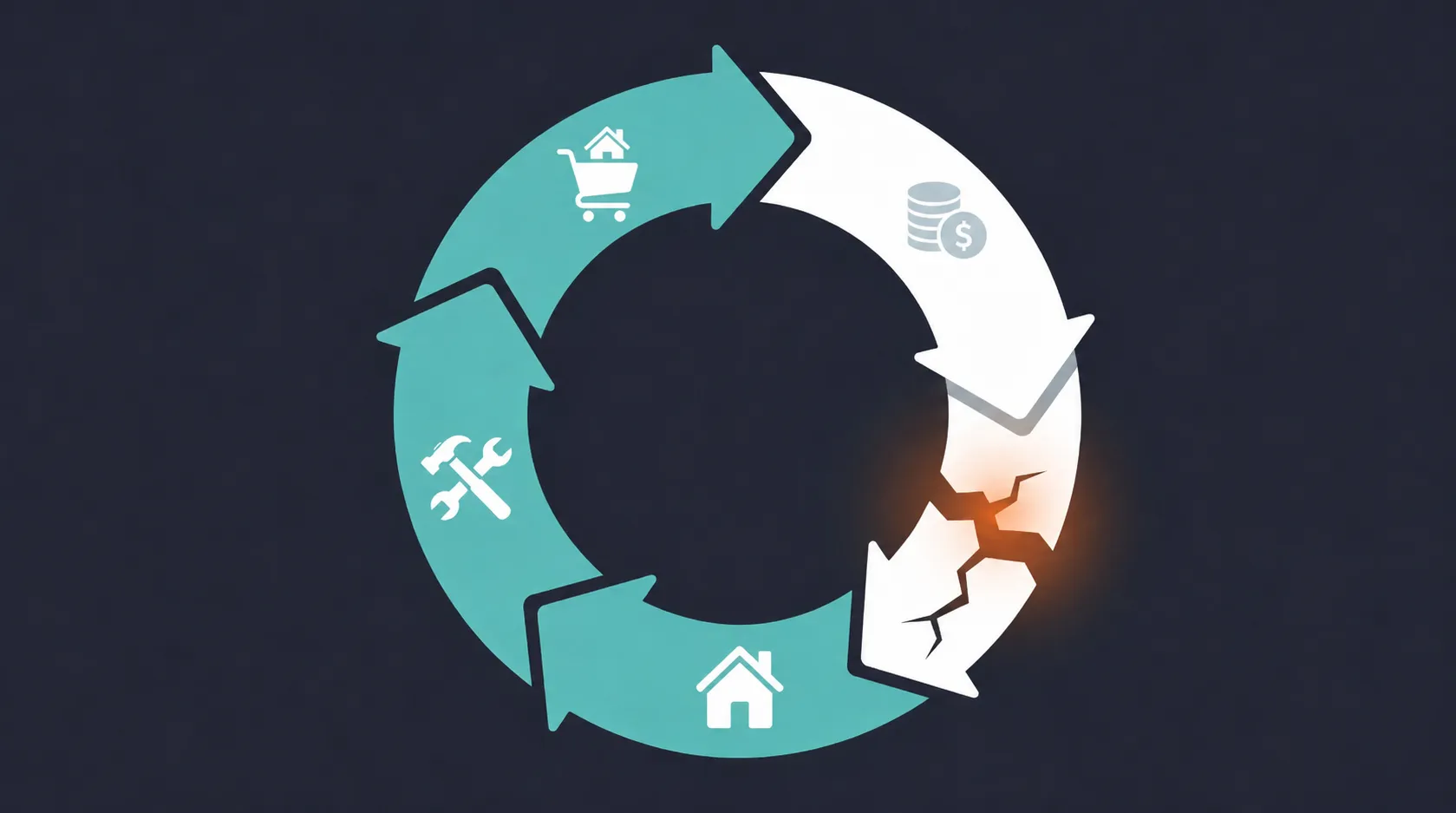
You've heard the pitch a hundred times. Buy a distressed property, rehab it, rent it out, refinance into a long-term loan, and repeat. The BRRRR strategy - Buy, Rehab, Rent, Refinance, Repeat - is the most discussed wealth-building framework in real estate investing. Every podcast covers it. Every guru sells a course on it.
And none of them talk about what actually happens between "Rent" and "Refinance."
That gap, the 60 to 90 days (sometimes longer) between finishing your rehab, getting a tenant in place, and closing your DSCR (Debt Service Coverage Ratio) refinance, is where the strategy breaks down in practice. Not because the math is wrong, but because the execution is harder than the whiteboard version suggests.
If you've done a flip or two and you're ready to hold your next project as a rental instead of selling it, this is the article the podcasts skip.
The Strategy Everyone Teaches vs. the Execution Nobody Talks About
On paper, BRRRR is elegant. You buy a property below market value with a short-term rehab loan, renovate it to force appreciation, place a tenant, then refinance into a 30-year DSCR loan that pays off the short-term debt and (ideally) returns most of your capital so you can do it again.
The concept is simple. The execution has friction points that cost real money, and most of them live in the transition between your rehab loan and your permanent financing.
Here are the five gaps that catch investors off guard - and what to do about each one.
Gap 1: Seasoning Requirements Lock Up Your Capital
Most DSCR lenders require a "seasoning period" before they'll refinance a property you recently acquired or renovated. That means 6 to 12 months of ownership before you can pull cash out at the after-repair value.
Why this matters: If you bought a property for $180K, put $60K into rehab, and it's now worth $320K, you want to refinance at 75% of that new value ($240K) to pay off your $240K total cost and recycle your capital. But if the lender requires 6 months of seasoning from the purchase date, your money is stuck for half a year. You're paying short-term loan interest rates the entire time, or you've already paid off the rehab loan and your cash is sitting in a property earning rent but not recycling into your next deal.
That's not a BRRRR. That's a BRRR... wait... R.
What to plan for: Before you finance the rehab, ask your DSCR lender about their seasoning rules. Some lenders, including Upright, have no seasoning requirement on rate-and-term refinances (where you're simply replacing one loan with another at the current balance). Others require 3, 6, or 12 months depending on whether you want cash out. Upright Lending allows delayed purchases on DSCR loans, which means if you bought the property with cash or paid off your rehab loan, you can still finance or refinance without a standard seasoning penalty. We also have no seasoning requirements on rate & term refinances. On cash-out refinances, we will use the sum of your original purchase price, closing costs, and all-in rehab budget as your value (assuming the market value is higher), and lend up to 75% of that total, until you've owned it for at least 6 months. After 180 days of ownership, we'll simply look at the flipped value. With 30 days being plenty of time to close your loan, we can get started when you hit month 5, and close on day 181. Know the rules before you commit capital.
Gap 2: Two Lenders Means Two Underwriting Cycles
Here's a scenario that plays out constantly: You get your rehab loan from Lender A. You finish the project, place a tenant, and apply for a DSCR refinance with Lender B. Lender B has never seen your file. They need your ID, experience, entity docs, credit authorization, background check, bank statements, property appraisal, lease, and insurance, all from scratch.
You just went through this entire process 6 months ago with Lender A. Now you're doing it again, with a different team, different systems, different timelines, and different communication styles.
The re-underwriting adds 2-4 weeks to your timeline, minimum. It also introduces risk: Lender B might value the property differently, interpret your entity structure differently, or have guidelines that create surprises at the closing table.
What to plan for: The cleanest BRRRR execution happens when the same lender handles both the short-term rehab loan and the long-term DSCR refinance. When Upright Lending originates your rehab loan, your entity documents, borrower background, credit, and experience verification are already on file. Rolling into a DSCR refinance requires only updated bank statements, a lease agreement, landlord insurance, a new valuation, and updated title. The heavy lifting is already done. The same team, one file, one set of expectations.
Gap 3: Carrying Costs During the Transition Eat Your Margin
This is the gap that kills profitability on paper-thin deals. Your rehab loan is charging interest, typically in the 9-11% range, for every day it remains outstanding. If your rehab takes 4 months and the DSCR refi takes another 2 months to close, you're paying short-term interest for 6 months on a loan you planned to hold for 4.
On a $240K loan balance at 10%, that's $2,000/month in interest. Two extra months of carry costs is $4,000 straight off your bottom line. On a deal where your total spread is $30-40K, that's 10-13% of your profit gone to transition friction.
And that's before you factor in the cost of vacancy if you're still finishing rehab, or the cost of two separate closings (origination fees, title insurance, recording fees) if your short-term and long-term lenders aren't the same shop.
What to plan for: Build 60 days of buffer into your carry-cost projections. Always. If you think the project will take 4 months, budget interest for 6. If you think the DSCR refi will close in 30 days, budget for 45. The investors who get burned on BRRRR aren't the ones who miscalculate the ARV; they're the ones who underestimate the timeline between finishing the work and locking in permanent financing.
Better yet, have your DSCR application ready to submit the day the tenant signs the lease. If your rehab lender and DSCR lender are the same company, this can happen in parallel instead of sequentially.
Gap 4: The Appraisal Mismatch Between Lenders
Your rehab loan was underwritten based on an ARV estimate; what the property will be worth after renovations. Your DSCR lender orders a new appraisal on the completed property. These two numbers don't always agree.
If your rehab lender underwrote to a $320K ARV and your DSCR lender's appraiser comes in at $295K, your maximum cash-out just dropped by nearly $19K (at 75% LTV). That might mean you don't get all your capital back, which breaks the "Repeat" part of BRRRR.
This isn't necessarily anyone's fault. The Appraisers are evaluating market data at different times, using different comps, making different adjustments, and having different opinions. But when you're counting on a specific refi amount to recycle your capital, a 5-8% appraisal miss changes the entire equation.
What to plan for: Don't build your BRRRR model assuming you'll get 100% of your capital back. A conservative target is recovering 80-90% of your cash invested. If the deal still works at those recovery rates, it works. If it only pencils if you get every dollar back at the exact ARV you projected, the margin is too thin.
Also: the best time to address an appraisal gap is before it happens. If you stay with the same lender for both loans, the valuation philosophy and vendor network stay consistent. It doesn't guarantee the numbers match, but it removes the variable of a completely different appraiser with a completely different methodology.
Gap 5: You Can't Start Deal Two Until Deal One's Refi Closes
This is the compounding cost that nobody talks about on the podcasts. BRRRR only works as a wealth-building strategy if you can actually repeat it. That means recycling capital from Deal 1 into Deal 2.
But if your capital is locked in Deal 1 for 6-9 months between acquisition, rehab, lease-up, and refi close, you're doing one deal per year. Maybe two. The "Repeat" part of BRRRR isn't a strategy at that pace; it's just buying rental properties slowly.
The investors who actually scale with BRRRR have compressed the transition timeline to the point where Deal 2's acquisition can happen while Deal 1's refi is in process. That requires either enough liquid capital to run two deals simultaneously, or a refi process fast enough that capital recycles before the next opportunity passes.
What to plan for: If you're running your first BRRRR cycle, don't expect to have capital ready for Deal 2 immediately. It's going to take longer than you think. Plan for a 9-10 month full cycle on your first one: 1-2 months to acquire, 3-4 months to rehab, and 1-3 months to lease up and close the refi. Once you've done it and you know where your specific friction points are, the second cycle gets faster.
The biggest acceleration comes from shortening the refi timeline. If your DSCR lender already has your file, your docs, and your track record from the rehab loan, you can shave weeks off the process. That's not a theoretical advantage; it's the difference between recycling capital in 7-8 months vs. 12.
Running the Numbers: What the Execution Gap Actually Costs
Let's walk through a real scenario to make this concrete. Same deal, two different execution paths. The difference is how long the transition takes and how much carrying cost you burn during the gap.
The Deal: Purchase price: $185,000. Rehab budget: $55,000. After-repair value: $310,000. Monthly rent: $2,100.
Path A: Two Different Lenders
You close the rehab loan with Lender A in 30 days. Rehab takes 4 months. You place a tenant in month 5. You apply for a DSCR refi with Lender B, who has never seen your file. Full re-underwriting: entity docs, credit, background, bank statements, appraisal, lease, insurance - all from scratch. Lender B needs 45 days to close. Your rehab loan stays outstanding for 6.5 months total.
Rehab loan interest (6.5 months at 10% on ~$220K avg balance): ~$11,900. Lender A origination (2%): ~$4,800. Lender B origination (2%): ~$4,650. Two sets of title, recording, closing costs: ~$6,000. Total financing friction: ~$27,350.
DSCR refi at 75% of $310K ARV = $232,500 loan. After paying off $240K total cost... you're $7,500 short. You left money in the deal, paid over $27K in financing friction, AND it took 7.5 months from acquisition to capital recovery.
Path B: Same Lender, Both Loans
You close the rehab loan with Upright Lending in 10 days. Rehab takes 4 months. Tenant signed in month 5. Because Upright already has your entity docs, borrower background, credit, and experience on file, the DSCR refi application is submitted the day the lease is executed. Instead of 45 days of re-underwriting from scratch, the refi closes in roughly 2-3 weeks. Your rehab loan is outstanding for 5.5 months instead of 6.5.
You're still paying two origination fees, two sets of title and closing costs. Those are two separate loans. Here's what the numbers look like:
Rehab loan interest (5.5 months at 9.5% on ~$220K avg balance): ~$9,600. Upright RTL origination (1.5%): ~$3,600. Upright DSCR origination (1%): ~$2,325. Two sets of title, recording, closing costs: ~$5,500. Total financing friction: ~$21,025.
Same refi amount: $232,500. After $240K total cost, you're still ~$7,500 in the deal. But your total financing friction dropped from ~$27,350 to ~$21,025 - a savings of over $6,300. Part of that is the lower origination fees (Upright averages 1.5% on RTL, 1% on DSCR vs. the 2% industry norm). Part of it is the month of carry you didn't pay because the refi closed faster. And you got your capital back 6 weeks sooner.
On a deal with $30K of total margin, $6,300 is more than 20% of your profit recovered. But those 6 weeks matter just as much. That's 6 weeks earlier you can put an offer on Deal 2. Over a two-year period where you're running multiple BRRRR cycles, compressing each transition by 4-6 weeks is the difference between completing three cycles and completing five. The math on the individual deal is real. The math across your portfolio is transformational.
What to Have Ready Before You Start Your First BRRRR
If you're transitioning from flipping to holding, here's the prep work that makes the execution clean:
Before you buy:
- Identify your DSCR lender before you close the rehab loan. Ideally, it's the same lender. Know their seasoning rules, LTV caps, and minimum DSCR requirements.
- Run the rental numbers alongside the flip numbers. What does the property rent for? What's the DSCR at your expected refi loan amount? If the DSCR is below 1.0x, you'll need 6 months of reserves instead of 3, and your rate will be higher.
- Budget carry costs for the full cycle, not just the rehab phase.
During rehab:
- Document everything. Invoices, permits, inspections. This becomes your experience file for future deals and helps the DSCR appraisal support the ARV.
- Start marketing the rental 2-3 weeks before rehab completion. The fastest way to compress the gap is to have a signed lease ready the moment the last contractor walks out.
At lease-up:
- Submit your DSCR application immediately. If your lender already has your file from the rehab loan, this should take a day, not a week.
- Have your landlord insurance policy in the works before you apply. This is a common delay item.
- Current bank statements showing reserves (3-6 months PITIA depending on your DSCR ratio).
The Bottom Line
BRRRR works. The math is sound. The strategy builds wealth. But the investors who actually execute it profitably are the ones who plan for the execution gap between the rehab and the refinance, not just the whiteboard version.
The fastest way to close that gap is to eliminate the friction between your short-term and long-term lender. One file. One team. One underwriting cycle. Capital recycled in months instead of quarters.
If you're ready to hold your next project instead of flipping it, start with a lender who can take you from acquisition through permanent financing without handing you off.
Call (216) 206-6079 or start your application at uprightlending.com.
Already running BRRRR with two different lenders? We can still handle the DSCR side and make your next cycle faster. Learn more about our DSCR program.
Ready to fund your next deal?
Partner with a lender who understands your investment strategy.
Subscribe to Our Blog
Get the latest insights, market trends, and investment strategies delivered to your inbox.