
Draws in Minutes, Closings in Days: Our Real Numbers
Our actual numbers: a Holdback release disbursed in 39 minutes, a median of 20 hours, and a signed term sheet to a funded wire in three days.
Most lenders talk about speed. Here is ours, measured, for the week and the year to date.
Your framer finishes the rough-in on a Tuesday. He wants a check.
You submit for a release. Then you wait, and the waiting is the part you cannot plan around. Not because anybody is ignoring you, but because you have no idea whether the answer comes in a day or in two weeks.
So you float it. You put the framer on your own card, or you slow him down, or you call three times to find out where the file sits.
That gap is the thing we spend our time closing. Not the marketing version of speed. The measured kind.
What last week actually looked like
Every Holdback release we processed last week, start to finish:
The slowest one is the number worth sitting with. Even the file that took the longest cleared inside two days. There was no outlier week, no single release stuck for a long weekend while somebody chased a photo.
Why the clock moved
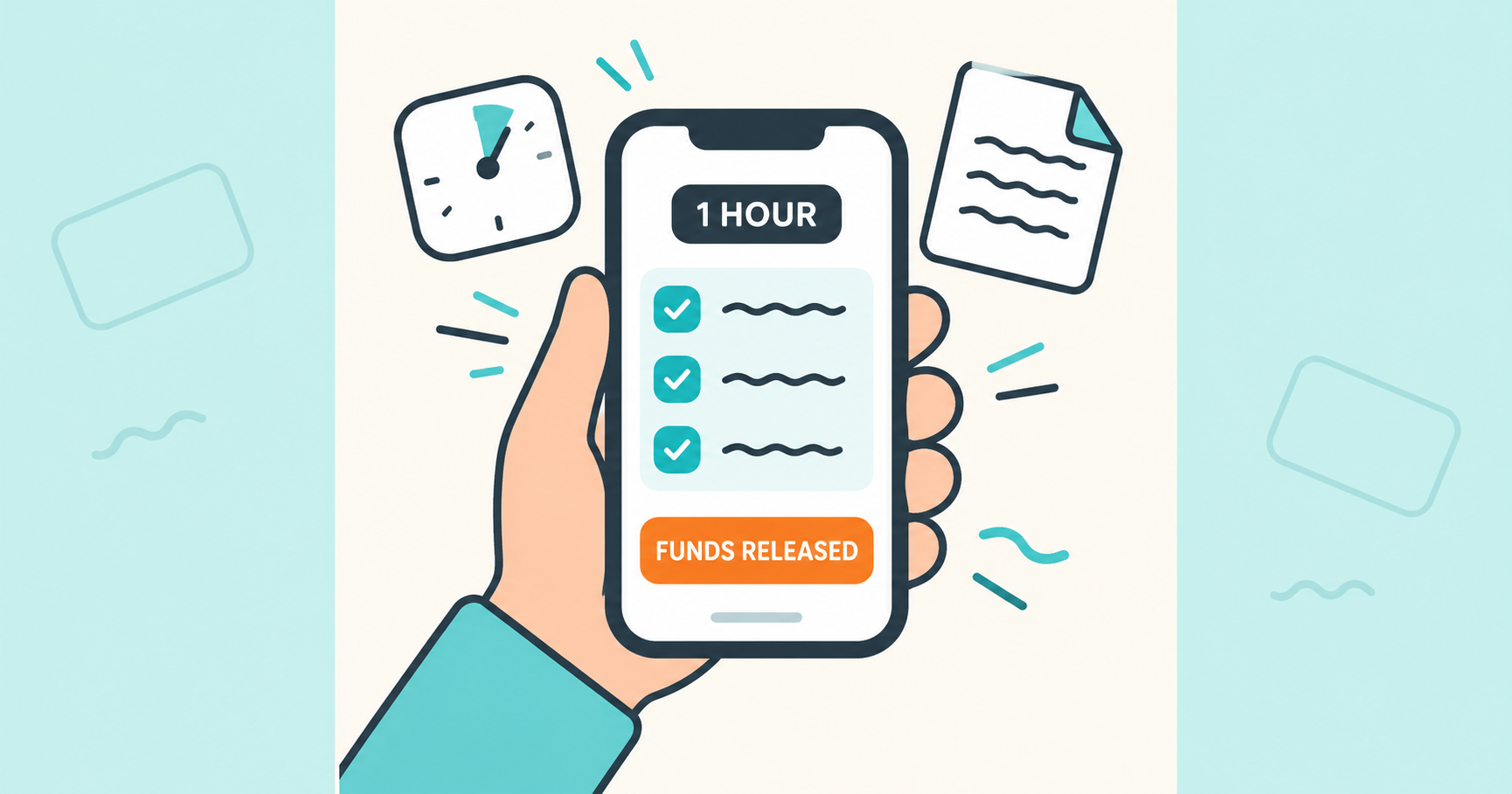
Your budget, your release requests, and your inspection now live in one place. You open one app. You see your Scope of Work line by line, you request against the lines that are done, and you walk the property on your phone for the inspection instead of scheduling someone to drive out.
That last piece is most of the hour. An inspection that used to be a calendar problem is now a ten minute video walk you do when you are already standing there.
The closing clock
Releases are one half of it. The other is getting your money the first time.
Year to date, our fastest file went from a signed term sheet to a funded wire in three days. Twelve recent files closed in ten days or less. Those were rehab, new construction, and bridge deals across six states, so this is not one unicorn closing we keep pointing at.
Why the clock is shorter than it looks
All of the work necessary to approve your project happens in parallel. That is the part of how it works you do not see.
You can start uploading documents the moment you apply, while we are still finalizing your terms. Those two things run beside each other instead of in line.
On most files, your inspection is a ten minute walk you do yourself. Geotagged, geofenced, timestamped photos from your phone, or from someone on your team, and we build the valuation from that. On an auction property it is often the only real look anyone gets at the asset, which is worth something on its own.
We verify your experience ourselves instead of sending you off to assemble it. We keep title moving. We bring you two preferred insurance quotes to weigh against your own agent's.
What we do with that time
We are not just clearing conditions. We are reading the deal.
We check whether the numbers work, because we do better when you do. We check whether the budget is buildable, because a project that runs short of money stops being a project. We look at the liquidity the deal asks of you, your credit, and a clean background.
That is the work. When it is finished, it is finished, and nothing sits in a queue waiting on someone to notice it.
The part we control, measured separately
Term sheet to wire includes your calendar as well as ours. Your seller sets a date. Your appraisal gets scheduled. Sometimes you want three weeks on purpose.
So we also measure the window that is entirely ours: from the moment your file clears to close, to the moment the wire goes out. Across hundreds of loans, the median is one day. Eighty two percent funded within a single day of clearing.
That is the number to hold us to, because it is the only one where every variable belongs to us.
What this has to do with being an extension of your team
A team member is someone whose work you can plan around. That is the whole definition. You do not need them to be fast every single time so much as you need to know what to expect, so you can tell your framer Thursday and mean it.
That is what the numbers are for. Not a claim, a range you can build a schedule on.
It is also why the same people stay on your file. The branch that funded your first deal already has your entity documents, your insurance agent, your title contact, and your contractor's pricing. By the third project, a release request gets read instead of investigated, because the person reading it already knows what your invoices look like.
If you are running three deals at once, that difference compounds into weeks a year.
The Bottom Line
We publish these because you should be able to plan around them. A Holdback release last week cleared in a median of twenty hours and never took more than forty four. Twelve files this year funded in ten days or less, the fastest in three. Once a file clears to close, we wire in a median of one day.
One capital partner across the whole lifecycle, one app for your budget and releases, and the same branch on every deal. If you want the terminology behind any of this, our glossary has it.
Call (216) 206-6079 or start your application at uprightlending.com.
Ready to put a real date on your next closing? Start your application.
Ready to fund your next deal?
Partner with a lender who understands your investment strategy.
Subscribe to Our Blog
Get the latest insights, market trends, and investment strategies delivered to your inbox.